

The Power Broker of Modern Boxing: Turki Alalshikh
In the ever-shifting world of professional boxing—long defined by rival promoters, fractured championships, and elusive superfights—few figures have emerged as quickly and decisively as Turki Alalshikh. Though not a traditional promoter, matchmaker, or broadcaster, Alalshikh has, in a remarkably short span of time, become arguably the most influential individual in the sport.
His rise is not rooted in boxing gyms or sanctioning bodies, but in political power and financial scale. As a senior adviser in Saudi Arabia’s royal court and chairman of the General Entertainment Authority, Alalshikh operates at the intersection of sport, government, and global entertainment. Through Saudi Arabia’s Vision 2030 initiative—a national strategy to diversify the economy and expand cultural influence—he has been tasked with transforming the Kingdom into a global destination for major events. Boxing, with its global appeal and history of spectacle, has become one of his most effective tools.
Rewriting the Economics of Boxing
For decades, boxing has been constrained not by a lack of talent or fan interest, but by economics and politics. The biggest fights often failed to materialize due to disputes over revenue splits, broadcast rights, and promotional control. Alalshikh has effectively bulldozed those barriers.
By injecting vast financial resources into the sport through initiatives like Riyadh Season, he has made it possible to stage fights that previously stalled in negotiation limbo. Fighters who might have spent years circling each other can now be brought together under terms too lucrative to ignore. Promoters, traditionally protective of their own ecosystems, have shown an unprecedented willingness to collaborate when backed by Saudi funding.
This shift has had a profound impact. In a sport where negotiations can take years and often collapse entirely, Alalshikh’s involvement has accelerated timelines and raised expectations. The question is no longer “can this fight be made?” but rather “when and where?”
Building a New Boxing Hub
Historically, boxing’s major events have been concentrated in cities like Las Vegas, New York, and London. Under Alalshikh’s leadership, Riyadh has rapidly joined—and in some cases surpassed—those traditional hubs.
High-profile events featuring elite heavyweights and championship bouts have been staged with a scale and consistency rarely seen elsewhere. These cards often resemble festivals more than fight nights, stacking multiple world-class matchups into a single event. The result is not just a shift in geography, but a redefinition of what a premium boxing event can look like.
For fighters, the appeal is obvious: higher purses, global exposure, and the opportunity to compete on some of the most lavishly produced stages in the sport. For fans, the benefit has been a surge in meaningful matchups delivered in quick succession.
A Unifier in a Divided Sport
One of boxing’s most persistent challenges has been its fragmentation. Unlike mixed martial arts, which is largely unified under organizations like the Ultimate Fighting Championship, boxing operates through a patchwork of promoters, networks, and sanctioning bodies. This structure has historically made cooperation difficult.
Alalshikh, however, has managed to achieve what many thought impossible: bringing rival promoters to the same table. Organizations that once operated in isolation—such as Top Rank and Golden Boy Promotions—have participated in events backed by Saudi funding. While these alliances may be temporary and transactional, they represent a significant departure from the norm.
In effect, Alalshikh has become a neutral power center—one with enough financial leverage to align competing interests, at least for the duration of a major event.
Beyond Promotion: Shaping the Future
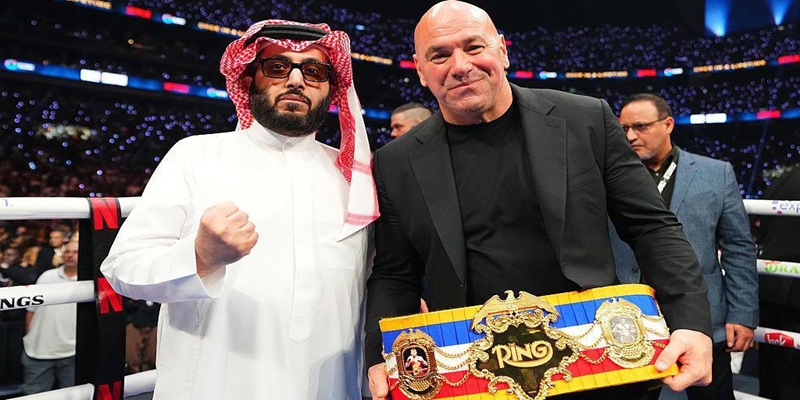
Alalshikh’s ambitions extend beyond simply staging big fights. He has shown a clear interest in reshaping the structure of boxing itself. His involvement in ventures like Zuffa Boxing—alongside figures such as Dana White—signals a desire to explore more centralized, UFC-style models of promotion.
Such a system would aim to reduce fragmentation, streamline matchmaking, and create a more consistent product for fans. While significant legal and structural hurdles remain—not least the constraints of the Muhammad Ali Boxing Reform Act—the very pursuit of this model reflects a growing appetite for change within the sport.
In addition, Alalshikh’s acquisition of influential boxing media assets has expanded his reach beyond events and into the narratives that shape the sport. Control over both the platform and the storytelling gives him a unique position from which to influence boxing’s direction.
Criticism and Questions of Sustainability
Despite the undeniable impact, Alalshikh’s rise has not been without controversy. Critics have pointed to the broader political context of Saudi Arabia’s investment in global sports, arguing that it serves as a form of image enhancement on the international stage. Others question whether the current level of spending is sustainable in the long term, or whether boxing risks becoming overly dependent on a single financial source.
There are also concerns about centralization. While Alalshikh’s ability to unify promoters has been beneficial in the short term, it raises questions about what happens if too much influence becomes concentrated in one individual or entity.
A Defining Figure of This Era
What cannot be disputed is the scale of Turki Alalshikh’s influence. In just a few years, he has altered the rhythm, geography, and economics of professional boxing. Fights are happening more quickly, cards are becoming more ambitious, and the sport’s center of gravity is shifting.
Whether this transformation represents a sustainable evolution or a temporary surge remains to be seen. But for now, Alalshikh stands at the center of boxing’s modern era—not as a traditional promoter, but as something far more powerful: a facilitator, financier, and architect of possibility.
In a sport long defined by its divisions, he has introduced a new dynamic—one where, at least for the biggest fights, barriers can be removed almost overnight. And in doing so, he has forced boxing to confront a new reality: the future may belong not to those who control fighters, but to those who can bring everyone together.