


The Golden Boy Fallout: How Richard Schaefer Nearly Toppled an Empire
In the early 2010s, Golden Boy Promotions stood as one of the most powerful entities in boxing. Founded by Oscar De La Hoya, the company had built a formidable roster of elite fighters and positioned itself as a major rival to Top Rank. With strong television relationships and a growing stable of stars, Golden Boy appeared poised to dominate the sport for years to come.
But behind the scenes, a corporate and personal crisis was quietly unfolding—one that would fracture the company, reshape the promotional landscape, and contribute to the rise of a new power broker in boxing: Al Haymon.
A Company Built on Dual Leadership
Golden Boy’s success was not solely the product of De La Hoya’s star power. Equally instrumental was Richard Schaefer, the company’s CEO.
Schaefer, a former banker, handled the business and operational side of Golden Boy, negotiating broadcast deals, managing fighter contracts, and maintaining relationships with networks and sponsors. De La Hoya, meanwhile, served as the public face—the visionary and brand.
For years, the partnership worked. Together, they signed and promoted some of the biggest names in boxing, securing lucrative deals with networks like Showtime and HBO.
However, the balance of power within the company would be tested when De La Hoya stepped away.
Oscar De La Hoya’s Absence
In 2013, De La Hoya entered rehab to address personal issues, temporarily removing himself from day-to-day operations at Golden Boy Promotions. During this period, control of the company effectively fell to Schaefer.
What followed remains one of the most controversial episodes in modern boxing business history.
Without De La Hoya’s oversight, Schaefer continued to run Golden Boy—but the company’s internal dynamics began to shift. At the same time, Al Haymon, an influential adviser who managed a growing number of elite fighters, was increasing his footprint across the sport.
The Expiring Contracts
When De La Hoya returned, he reportedly discovered a troubling reality: several key Golden Boy fighters were no longer securely tied to the company.
Instead of being locked into long-term promotional agreements, many contracts had been allowed to expire. Fighters who had once been central to Golden Boy’s future were now free agents—or, more significantly, aligned with Al Haymon.
Among those affected were high-profile names who would later become pillars of Haymon’s boxing ecosystem.
The implications were enormous. In boxing, fighter contracts are the lifeblood of a promotion. Without them, a company’s leverage, matchmaking power, and broadcast value all diminish rapidly.
The Haymon Shift
Al Haymon was not a traditional promoter. He operated as an adviser, guiding fighters’ careers while building relationships with networks and sponsors. But by 2014, he was effectively assembling a parallel power structure within boxing.
As Golden Boy’s fighters migrated toward Haymon, the balance of power began to tilt.
This shift would soon materialize in the launch of Premier Boxing Champions (PBC), Haymon’s ambitious attempt to bring boxing to free and cable television on a large scale.
With a deep roster of fighters—many of whom had previously been associated with Golden Boy—PBC quickly became a dominant force.
The Breakup
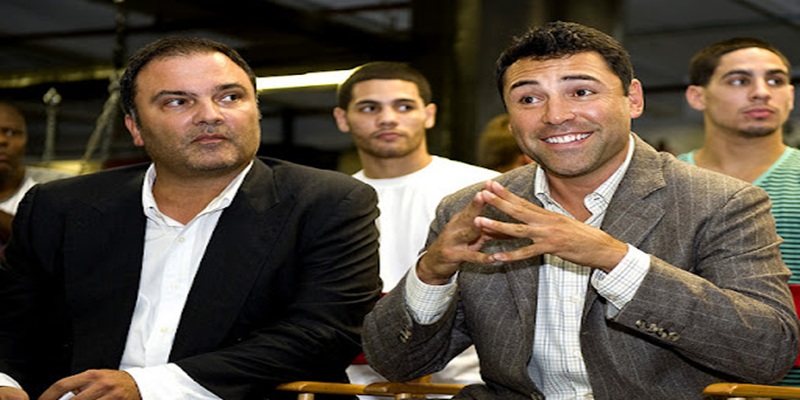
The fallout between De La Hoya and Schaefer was swift and decisive.
By 2014, Schaefer had exited Golden Boy Promotions. The split was acrimonious, marked by legal disputes, public accusations, and a complete breakdown of their once-successful partnership.
Golden Boy, once a unified powerhouse, was suddenly fractured:
- Its CEO was gone
- Its fighter roster had been significantly depleted
- Its influence in the sport had been weakened
Meanwhile, Haymon’s influence continued to grow.
Legal Battles and Industry Shockwaves
The situation triggered a series of legal and contractual disputes involving Golden Boy, Haymon, and various fighters.
Questions were raised about:
- Conflicts of interest
- The structure of advisory vs. promotional roles
- Whether fighters had been steered away from Golden Boy
Although many of these disputes were eventually settled or faded from public view, the damage had already been done.
The episode exposed the fragility of boxing’s business model—where relationships, influence, and contract timing can outweigh formal structures.
Long-Term Impact on Boxing
The Golden Boy–Schaefer fallout had consequences far beyond a single company.
1. The Rise of Al Haymon
Haymon emerged as one of the most powerful figures in boxing, with PBC securing major broadcast deals and controlling a significant share of elite fighters.
2. Increased Fragmentation
Rather than consolidating the sport, the split contributed to further division between promotional camps, making cross-promotional fights even more difficult.
3. A Cautionary Tale
For promoters, the episode underscored the importance of:
- Contract security
- Internal governance
- Clear separation of roles between advisers and promoters
4. Golden Boy’s Reinvention
Despite the setback, Golden Boy Promotions survived. Under De La Hoya’s renewed leadership, the company rebuilt its roster and later aligned with new broadcast partners, including DAZN.
Myth vs. Reality
Over time, the story has taken on an almost mythological quality within boxing circles.
Some portray it as a calculated move by Schaefer to align with Haymon. Others view it as a failure of oversight during De La Hoya’s absence. The truth likely lies somewhere in between—a combination of strategic maneuvering, contractual timing, and the unique fluidity of boxing’s business structure.
What is clear, however, is that the episode fundamentally altered the sport’s power dynamics.
Final Thoughts…
The Golden Boy scandal of the early 2010s was more than an internal dispute—it was a turning point in modern boxing.
It marked the decline of one promotional empire’s dominance, the rise of another power center, and a stark reminder of how quickly fortunes can change in a sport built on relationships and leverage.
For Oscar De La Hoya, it was a costly lesson in corporate control. For boxing, it was a moment that reshaped the industry—one contract at a time.