

The Evolution of Boxing: BKFC vs Dirty Boxing Championship
In the last decade, the landscape of combat sports has fractured into specialized niches. No longer is a fan forced to choose between the sweet science of traditional boxing or the multi-disciplinary complexity of Mixed Martial Arts (MMA). Leading this charge into a new era of “hyper-striking” are two of the most talked-about promotions in the world: the Bare Knuckle Fighting Championship (BKFC) and the newcomer on the block, Mike “Platinum” Perry’s Dirty Boxing Championship (DBX).
While both organizations share a spiritual DNA—centered on raw aggression, high-octane finishes, and a “tough-man” aesthetic—they represent two very different philosophies on how a fight should be conducted. To understand the future of the industry, one must look at the technical, structural, and cultural differences between these two titans of the ring.

- Betfred Boxing
- Competitive Odds
- Boxing Specials
- Special Offers
Betfred: New customers only. Register, deposit with Debit Card, and place first bet £10+ at Evens (2.0)+ on Sports within 7 days to get 3 x £10 in Sports Free Bets & 2 x £10 in Acca Free Bets within 10 hours of settlement. 7-day expiry. Eligibility & payment exclusions apply. Full T&Cs apply. BeGambleAware.
The Common Thread: The “Platinum” Influence
Before diving into the differences, it is impossible to discuss either promotion without mentioning Mike Perry. Perry is the bridge between these two worlds. After a storied career in the UFC, Perry reinvented himself as the “King of Violence” in BKFC, becoming their biggest pay-per-view draw and the face of the sport.
However, Perry’s ambition didn’t stop at being an athlete. Recognizing a gap in the market for a “fighter-first” promotion that allowed for even more tools than bare-knuckle boxing—specifically elbows and ground-and-pound—he co-founded DBX. While he remains the top star of BKFC, he is the visionary and co-owner of DBX alongside UFC legend Jon Jones. This overlap has created a unique ecosystem where fighters often transition between the two, seeking the specific “flavor” of combat that suits their style.
1. Equipment: The “Bare” vs. The “Buffered”
The most immediate and visual difference between the two is what the fighters wear on their hands.
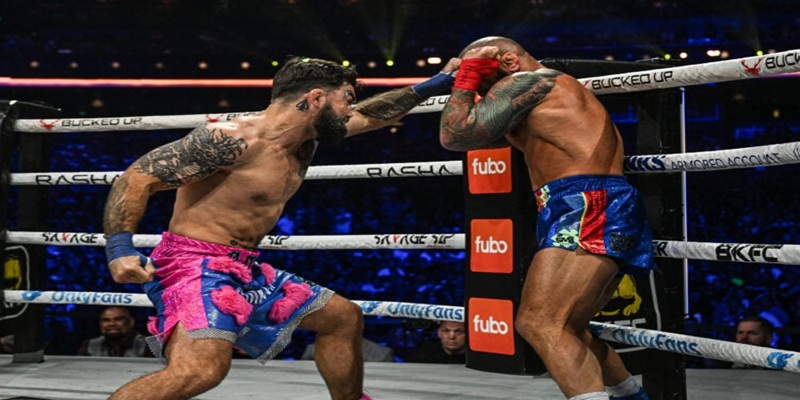
- BKFC (The Purest Form): As the name suggests, BKFC is strictly bare-knuckle. Fighters are permitted to wrap their wrists and thumbs for support, but the knuckles themselves must remain exposed. This drastically changes the mechanics of a fight; punches must be more accurate, and fighters cannot “hide” behind high guards or large gloves. Hand injuries are common, but the lack of padding often leads to more superficial cuts and rapid swelling, ending fights through “doctor stoppages” or precise knockouts.
- DBX (The Hybrid Approach): DBX utilizes a specialized 4-ounce glove. While this is slightly heavier than the 4-ounce gloves used in the UFC, it is a far cry from the 10-ounce pillows used in pro boxing. The goal of the DBX glove is hand protection rather than head protection. It allows fighters to throw with 100% power without the constant fear of breaking a metacarpal, leading to sustained, high-volume striking and devastating “dirty boxing” in the clinch.
2. The Rules of Engagement: Boxing vs. “Everything But Wrestling”
The technical ruleset is where these two promotions diverge most sharply.
BKFC is, at its heart, a boxing promotion. The rules are designed to keep the fight standing and focused on the hands. While “dirty boxing” (holding the back of the head and hitting) is allowed to an extent, referees are quick to break up clinches that become stagnant. There are no kicks, no knees, and absolutely no elbows. It is a test of who has the best “hands” in the world.
DBX, by contrast, is a striking laboratory. It identifies the “dead zones” of other sports and fills them with action.
- The “Dirty” Element: In DBX, elbow strikes and spinning backfists are fully legal. These are some of the most damaging weapons in combat sports and are usually banned in any form of boxing.
- Standing Ground-and-Pound: Perhaps the most radical rule in DBX is what happens when a fighter is dropped. In BKFC, a knockdown results in a traditional 10-count. In DBX, if a fighter is knocked down, the standing opponent can continue to rain down punches (ground-and-pound) as long as they remain on their feet. This eliminates the “breather” a downed fighter usually gets and ensures that when a fighter is hurt, the fight ends definitively.
3. The Architecture of Violence: The Ring Design
Both promotions realize that a large ring allows for too much movement and “running,” which can bore a modern audience.
- The BKFC “Squared Circle”: BKFC uses a unique circular ring with two lines in the center—the “Toe the Line” marks. At the start of every round, fighters must literally put their feet on these lines, starting the fight just inches away from each other. The circular design (approx. 22 feet) prevents fighters from getting trapped in a corner but keeps them close enough to exchange leather constantly.
- The DBX “DRING™”: DBX takes it a step further with an 18-foot square ring. By making the ring significantly smaller than a standard boxing ring, DBX removes the ability for a fighter to play a purely defensive, “evasive” game. There is nowhere to hide in an 18-foot ring; engagement is mandatory and immediate.
4. Scoring and Duration: Eliminating the “Boring” Draw
Pacing is a major priority for both organizations, but they approach it through different timing.
- BKFC Timing: Bouts are typically five rounds of 2 minutes each. The shorter rounds allow for a sprint-like pace where fighters don’t have to worry about “saving gas” for the later rounds.
- DBX Timing: DBX mirrors the MMA standard more closely with three rounds of 3 minutes each (five rounds for title fights). However, DBX has a “No Draws” policy. If the judges’ scorecards are tied at the end of the regulation rounds, the fighters enter a Sudden Death Overtime Round. This guarantees a winner and prevents the “anticlimax” of a split-draw decision.
5. The Roster: The Battle for Talent
Both promotions are currently competing for the same pool of world-class talent—specifically UFC veterans who still have plenty of “fight” left but want a more specialized platform.
- BKFC has successfully recruited legends like Eddie Alvarez, Luke Rockhold, and Chad Mendes. They focus on “names” that people recognize from the golden era of the UFC.
- DBX has taken a more “heavy-hitter” approach, signing massive power punchers like Yoel Romero, Andrei Arlovski, and Jairzinho Rozenstruik. Because DBX allows for ground-and-pound and elbows, it appeals more to “pure” MMA strikers who felt restricted by the bare-knuckle boxing format.
Which one is for you?
The choice between BKFC and DBX depends on what a fan values most.
If you appreciate the technical precision and grit of bare-knuckle striking—where one wrong move can break a hand or open a massive cut—BKFC is the gold standard. It feels like a throwback to the 1800s, modernized for a digital age.
If you want maximum violence and hybrid variety—the “best hits” of MMA striking without the wrestling—then Dirty Boxing Championship is the future. It is a faster, more chaotic version of combat that rewards the “dirty” clinch work that traditional sports try to clean up.